Optical Level, Rotary Laser or Line Laser? Pick the Right One Before You Buy
Buy the wrong levelling tool and you end up squinting for a laser beam you can't see in sunlight, or reading a staff when you needed a visible line on a wall.
These three tools are not “basic, better, best.” They do different jobs. Match the tool to the job and you'll save money and time.
This guide compares the optical level, the rotary laser and the line laser level, using Bosch Professional models as examples. For each one, you'll see what it does best, where it falls short, and the accessories you need to use it properly. We also cover how to read range and accuracy figures, how receivers pair with lasers, and how to look after your instrument. By the end, you'll know which tool fits your site and what to put in the order.
Quick pick
Start here. If your job is in the left column, read the section for the tool on the right.
| Your job | Best fit |
|---|---|
| Measuring height differences, transferring benchmarks | Optical level |
| Repeated level checks across an outdoor site | Rotary laser + receiver |
| Seeing a reference line while you install | Line laser |
Optical level: measure and compare heights
Example: Bosch GOL 32 D. You look through a telescope and read a graduated staff. Readings taken from one setup give you the height differences between points.

Good for: transferring a benchmark, comparing ground heights, checking foundation and slab levels, and checking formwork.
Key specs: 32× magnification, up to 120 m range, ±1.0 mm accuracy at 30 m. That accuracy figure applies at 30 m, not across the full range.
You'll need: a stable tripod (5/8-inch thread) and a graduated staff. Check whether your package includes them.
Watch out: it projects no visible line, and it works best with two people, one at the instrument and one on the staff. It's a poor choice for tiles or cabinets.
Rotary laser: check levels across a site
A rotating beam creates a level plane around the instrument. Outdoors, a receiver on a staff finds the beam for you, so one person can check heights around the site alone.
Good for: excavation, footings, concrete formwork and landscaping.
-
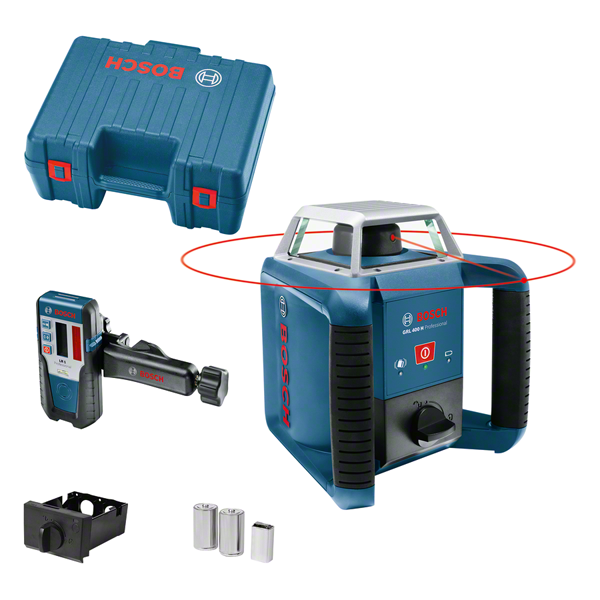
Bosch GRL 400 H: horizontal levelling only. ±2.4 mm at 30 m, up to 400 m diameter with a receiver. Uses the LR 1 Professional receiver.
-
Bosch GRL 600 CHV: horizontal, vertical and slope (single and dual axis). ±1.5 mm horizontal and ±3.0 mm vertical at 30 m, up to 600 m diameter with a receiver. Uses the LR 60 Professional receiver.
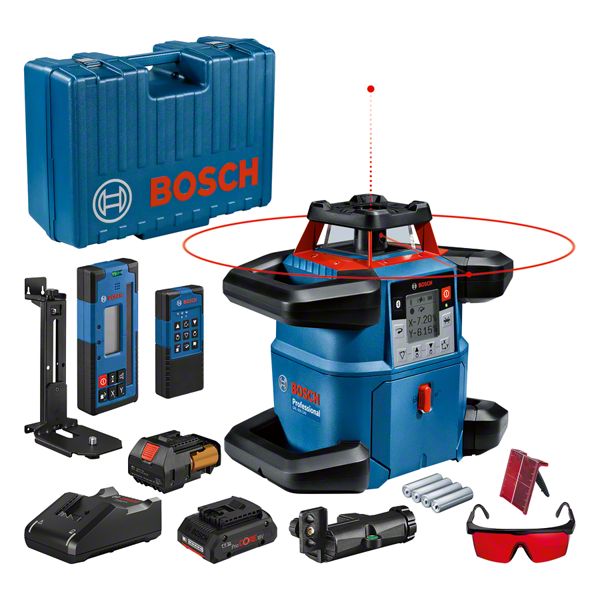
Consider the GRL 600 CHV if you need vertical work, controlled slopes, greater working range or tighter specified horizontal accuracy. A bigger range doesn't automatically make it the better buy.
You'll need: receiver and bracket, staff, tripod and batteries. Check what's in the package.
Watch out: the beam can be difficult to see outdoors, especially in bright sunlight, so plan to use a receiver.
Line laser: see the reference while you work
A line laser projects lines onto walls and floors, so the installer sees the alignment directly.
Good for: tiling, cabinets and shelves, window frames, partitions and suspended ceilings.
-
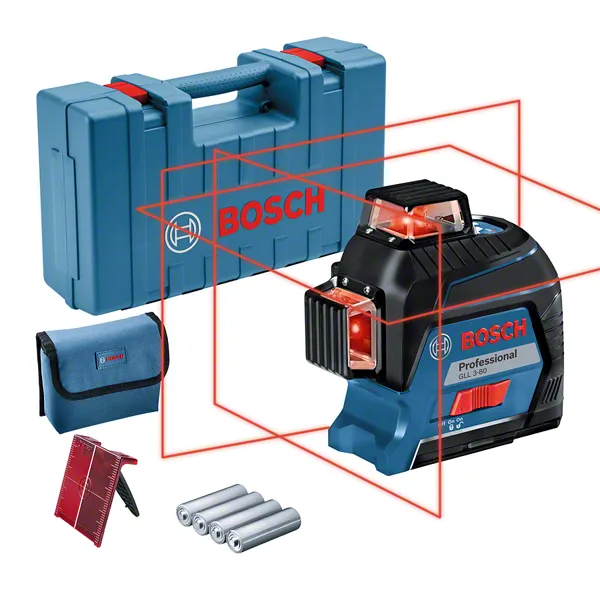
Bosch GLL 3-80 (red): three 360° lines, ±0.3 mm/m, 30 m range (120 m with a receiver). Suits controlled indoor lighting. Uses the LR 6 or LR 7 receiver.
-
Bosch GLL 80-33 G (green): same lines and same ±0.3 mm/m accuracy. Bosch says the green beam is up to four times more visible, so it suits bright rooms. Receiver range up to 80 m radius. Uses the LR 7 receiver.
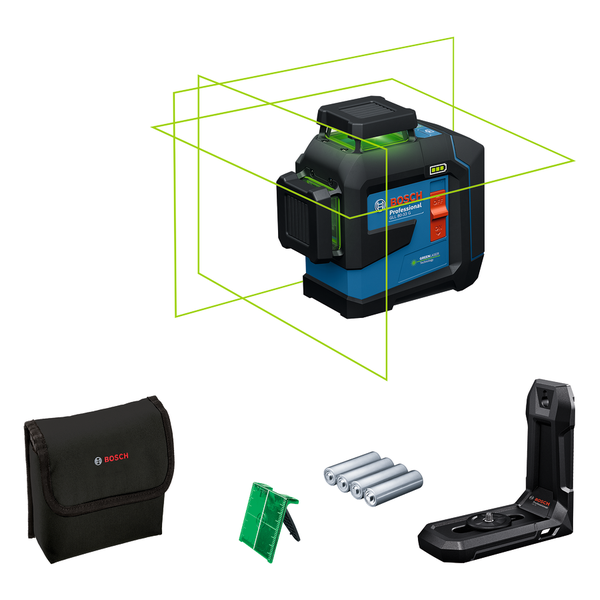
Green is not more accurate. It's easier to see, nothing more. It also won't beat strong outdoor sun on its own, so use a receiver for outdoor or long-distance work.
A line laser is not a distance meter. It projects references. A distance meter measures distance to a target. See our laser distance meter buying guide.
Receivers must match the laser
| Laser | Receiver |
|---|---|
| GRL 400 H | LR 1 Professional |
| GRL 600 CHV | LR 60 Professional |
| GLL 3-80 | LR 6 or LR 7 Professional |
| GLL 80-33 G | LR 7 Professional |
The LR 7 handles red and green line lasers, but it is not a universal receiver. A receiver helps detect the beam. It does not make the laser more accurate.
Reading range figures correctly
- Check whether a range is a radius, a diameter or a distance, and whether it needs a receiver.
- The 400 m diameter of the GRL 400 H means about 200 m from a central instrument to the edge. The 600 m of the GRL 600 CHV means about 300 m.
- Seeing a beam at distance and detecting it with a receiver are different. Neither means accuracy stays the same at distance.
Drainage falls
An optical level checks a fall by measuring the height difference between points. A 1% fall is 10 mm per metre, or 100 mm over 10 m. If you want the laser itself to project a slope, you need a slope-capable model like the GRL 600 CHV.
Don't confuse self-levelling range with slope capability. Self-levelling only corrects small setup errors.
Setup and care
- Self-levelling doesn't replace a stable setup. If the tripod or instrument gets knocked, recheck your reference.
- Check accuracy before starting work, after long transport and after any drop or impact.
- Bosch Professional recommends annual recalibration, and sooner after a potentially damaging event. This doesn't replace your routine checks.
So which one?
- Optical level: you measure heights and your team is comfortable with staff readings.
- Rotary laser + receiver: you do repeated checks across excavation, concrete or landscaping. Consider the GRL 600 CHV for vertical work, controlled slopes, greater working range or tighter specified horizontal accuracy.
- Line laser: you need a visible reference for installation. Red for controlled indoor light, green for bright spaces.
Mixed site and finishing work may need more than one. Before ordering, confirm your main task, required accuracy, working distance, lighting, number of operators and the full accessory package.