Laser Distance Meters: Don't Buy the Biggest Number on the Box
The longest range on the box won't tell you which meter to buy. A 150 m model is no help if you can't see the laser dot in sunlight, and it's overkill if you only measure rooms.
This guide explains what a laser distance meter does, what affects its readings, and how to choose one. By the end, you'll know which type fits the measurements you actually take.
Is it the same as a laser level?
No. A distance meter measures the distance to a target. A line or rotary laser sets a reference for levelling and alignment. Choose a meter for dimensions and a level for levels. Many jobs need both.
What it's good for
- Measuring rooms and checking installation spaces.
- Recording building dimensions.
- Calculating area (length × width) and volume (length × width × height) for rectangular spaces.
The result is a measurement, not a material estimate. Allow separately for waste, openings and overlaps. For irregular rooms, split the space into sections and calculate each one.
Which Bosch model suits your work?
Bosch Professional offers a range of GLM laser distance meters, from compact instruments such as the 25 m GLM 25-23 to longer-range models such as the 150 m GLM 150-27 C. Depending on the model, features can include area and volume calculations, inclination measurement, Bluetooth connectivity and a camera viewfinder for easier aiming. Model availability and package contents vary by market.
The three examples below illustrate different buying needs: straightforward measuring, digital documentation and longer-distance outdoor work.
Quick pick
| Model | Range | Typical accuracy | Best for |
|---|---|---|---|
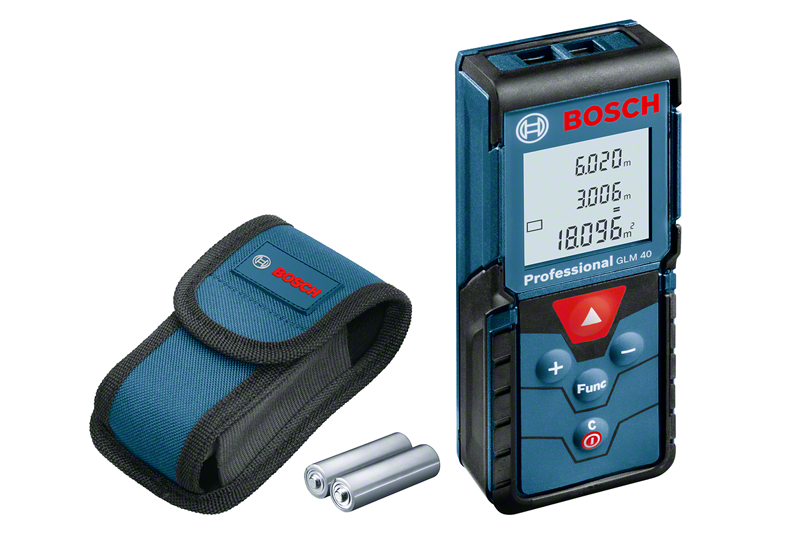
| Bosch GLM 40 | 0.15–40 m | ±1.5 mm | Indoor dimensions and basic calculations |
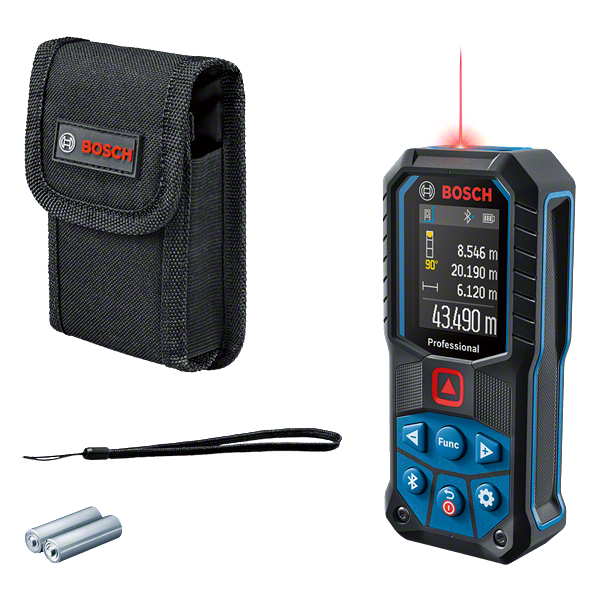
| Bosch GLM 50-27 C | 0.05–50 m | ±1.5 mm | Recording and transferring measurements |
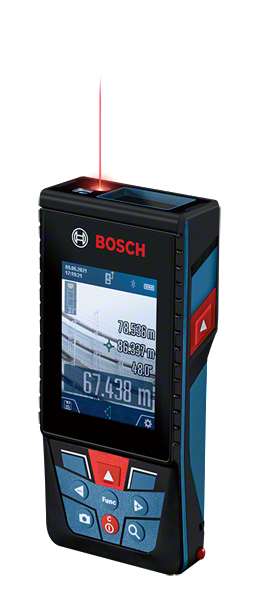
| Bosch GLM 150-27 C | 0.08–150 m | ±1.5 mm | Long distances and outdoor aiming |
The three models
GLM 40: simple and straightforward. Length, area, volume and indirect height. Stores the last 10 measurements. Runs on two AAA batteries. Choose it when you mainly measure indoors and don't need to document anything digitally.
GLM 50-27 C: built for documentation. Adds Bluetooth transfer to Bosch's MeasureOn app, an inclination function, a colour display, IP65 protection and a shock-absorbing housing. Runs on two AA batteries. Choose it when recording and organising measurements is part of the job. The extra value is the workflow, not just the extra 10 m.
GLM 150-27 C: for distance and daylight. A zoom camera viewfinder helps you aim at far targets. Transfers by Bluetooth to MeasureOn or by USB to a computer. Uses an integrated rechargeable lithium-ion battery. Choose it when finding the target outdoors or at distance is a regular problem. The camera helps you aim, but it doesn't fix poor lighting or a bad target surface.
MeasureOn availability: Bluetooth connectivity supports measurement transfer to Bosch's MeasureOn app. Before buying for this workflow, check app availability and compatibility on your phone. Cloud, subscription and export features vary by country.
Using one outdoors
It works, but choose for your conditions, not the maximum range. Range depends on lighting and how reflective the target is. In bright sun, the dot is hard to find. For occasional outdoor jobs, shade the target or use a target plate. For frequent long-distance work, consider a camera-viewfinder model.
What affects accuracy
The quoted accuracy is only part of the story. Bosch flags these as problem surfaces:
- Glass and water (transparent)
- Polished metal (reflective)
- Porous or heavily textured materials
Angled targets, temperature differences in the air and stray reflections also affect readings. Measure to a clearly identified, suitable target, and use a target plate if the surface is doubtful.
Never measure through glass. The beam can pass through or reflect, so you may measure something other than the surface you intended.
Check the reference point
Before you measure, check where the instrument measures from: front, rear or another point, depending on the model and setting. For a wall-to-wall reading, the wrong reference adds an error the length of the instrument itself. That is far bigger than the quoted tolerance.
Indirect measurements
Some models can measure a height or distance you can't reach directly. These are less accurate than direct readings, and movement or poor alignment makes them worse. Measure directly where you can. For indirect work, a compatible tripod helps.
Does it replace a tape?
Not entirely. Use the meter for room dimensions and accessible surfaces. Keep the tape for short component measurements, marking out and places with no usable laser target.
Accessories
- Spare batteries or the right charging equipment.
- A target plate for difficult surfaces.
- A tripod for long-distance and indirect work. Check that your model supports tripod mounting.
- If you need digital records, confirm the model's connectivity and the app or computer workflow you'll use.
Check the actual package contents before ordering.
Avoid common mistakes
- Confirm units and reference point first.
- Aim at the intended surface, not something in front of or behind it.
- Hold the instrument steady.
- Avoid glass and reflective surfaces unless you use a suitable method.
- Repeat important readings and investigate any unexpected difference.
- Follow the manual for accuracy checks and calibration.
Which should you buy?
- GLM 40: indoor dimensions and basic calculations.
- GLM 50-27 C: you need to transfer and document measurements.
- GLM 150-27 C: long-distance or outdoor work justifies a camera viewfinder.
Before ordering, confirm your typical distance, target surfaces, lighting, required functions and documentation needs. Buy for the measurements you actually take.